
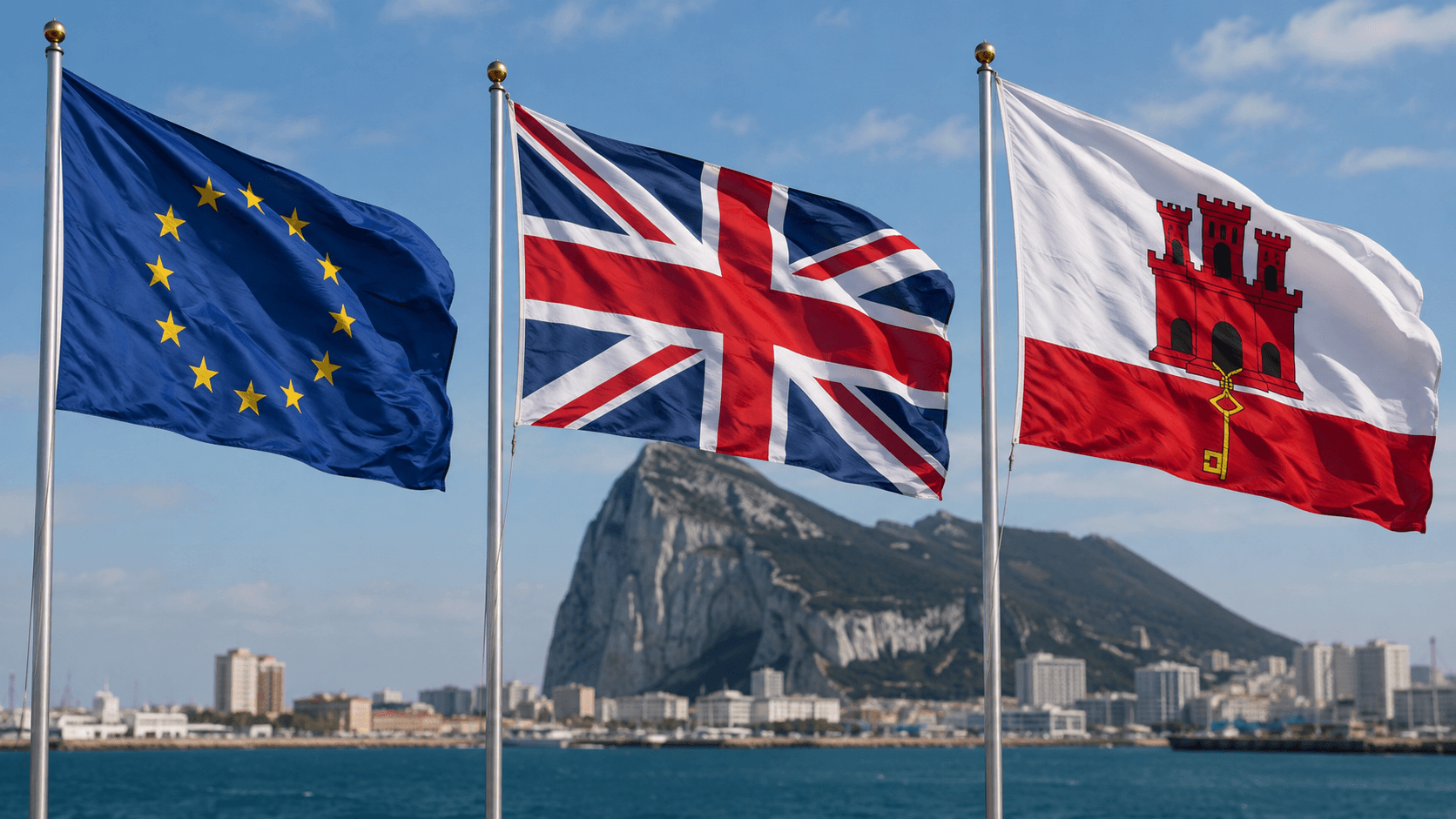


Since 15 July 2026, the UK-EU Gibraltar agreement has changed border control, residence rules, frontier work and social security coordination around Gibraltar.
The UK-EU Gibraltar agreement has been provisionally applied since 15 July 2026. Its most visible consequence is the removal of physical barriers between Gibraltar and Spain, yet its legal effects extend into residence, employment, social security and institutional cooperation.
One common assumption needs correcting from the start. Gibraltar has not joined the Schengen area, and border controls have not simply vanished. The agreement shifts the Schengen component of external border control to Gibraltar’s port and airport, where Gibraltar and Spanish authorities perform their respective checks.
The agreement was signed on 14 July 2026 and provisionally applied from the following day. As at 12 August 2026, the UK Parliament treaty tracker still lists the Gibraltar treaty among instruments currently before Parliament. Provisional application therefore remains the current legal position.
The treaty is much wider than travel. It contains provisions on people, employment, social security, customs, taxation, trade, transport, policing and institutional cooperation. This article focuses on the rules most likely to affect people and businesses moving between Gibraltar and Spain.
What changed on 15 July 2026?
A specific legal framework governing relations between the European Union and the United Kingdom in respect of Gibraltar started to apply provisionally on 15 July 2026. The treaty states that its objective includes shared prosperity for Gibraltar and the neighbouring area of Spain, with the Campo de Gibraltar specifically identified.
Provisional application (aplicación provisional) means that agreed treaty provisions can operate before all procedures for definitive entry into force have been completed. Council Decision (EU) 2026/1732 of 1 July 2026 authorised signature and provisional application on the EU side.
The agreement does not settle the sovereignty dispute. Its provisions are expressly without prejudice to the respective legal positions of Spain and the United Kingdom on sovereignty and jurisdiction concerning Gibraltar.
What changes is the legal management of everyday cross-border activity. The underlying sovereignty positions remain untouched.
Has the Spain-Gibraltar border disappeared?
The physical barriers connected with the movement of people are to be removed, but border law has not disappeared. Article 28 deals with removing those barriers, while Article 29 establishes border crossing points at Gibraltar’s airport and port.
That distinction matters.
- Before the agreement: the land frontier was the daily focal point for movement and border checks between Gibraltar and Spain.
- From 15 July 2026: the treaty provides for physical barriers at the land frontier to be removed while relevant external-border checks are carried out at Gibraltar’s port and airport.
Gibraltar does not become a Schengen territory as a result. The European Commission has stated that Gibraltar remains outside Schengen, even though Schengen rules are used to protect the common travel area created by the new arrangements.
For a traveller, therefore, removing the physical land barrier should not be read as abolishing legal entry conditions.
Who carries out the checks at Gibraltar airport and port?
Both Gibraltar and Spanish authorities have functions at Gibraltar airport and port. On entry, the competent Gibraltar authorities perform their checks first and the competent Spanish authorities follow; on departure, Spain checks first and Gibraltar follows.
Spain performs the functions required for Schengen border control (control fronterizo Schengen) under the Schengen Borders Code and the EU rules incorporated into the agreement. That protects the Schengen external border without making Gibraltar a member of Schengen.
Entry can still be refused. A third-country national who does not meet the applicable conditions may be refused entry under the treaty framework, subject to the special treatment of Gibraltar residents and other protected categories.
The practical model is therefore one of relocated and coordinated controls, rather than an uncontrolled land crossing.
Who can stay in Gibraltar for up to 90 days without a visa?
Article 41 provides visa-free entry and stay for up to 90 days in any 180-day period for several specified groups. They include EU citizens, qualifying third-country family members and third-country nationals legally resident in Member States applying the Schengen acquis in full.
The 90-day rule is a short-stay rule. It is not a residence permit and does not automatically confer a right to take paid employment.
Gibraltar residents, in turn, may enter and remain visa-free for up to 90 days in any 180-day period in Member States applying the Schengen acquis in full. The agreement also gives them specific external-border facilities, including exemptions from passport stamping and from EES and ETIAS requirements in the circumstances covered by the treaty.
Paid activity requires separate attention. Member States may decide to require a visa from Gibraltar residents travelling for paid work, while Gibraltar may impose a corresponding requirement on people covered by the visa-free rule who travel there for paid activity.
A visitor should therefore separate two questions: permission to enter for a short stay and permission to work.
Can Spain object to a Gibraltar residence permit?
Yes, in defined security-related circumstances. Gibraltar retains the power to issue and renew its residence permits, but the agreement creates a prior notification and objection mechanism involving Spain.
Before a relevant permit is issued or renewed, the Gibraltar authorities notify Spain. Spain has a 28-calendar-day period in which it may object where the applicant is considered, under the applicable Schengen rules, a threat to public policy, internal security, public health or the international relations of a Member State, including where a relevant Schengen Information System alert exists.
This is not a general Spanish veto over Gibraltar immigration policy. The mechanism is tied to specified security grounds arising from Gibraltar’s new relationship with the Schengen external border.
For applicants, it creates an extra legal stage that can matter even though the residence permit itself remains a Gibraltar document.
Who qualifies as a frontier worker?
A frontier worker (trabajador fronterizo) is, broadly, a person covered by the agreement who legally resides on one side, works as an employee or self-employed person on the other side and normally returns to the territory of residence at least once each week.
An EU citizen legally resident in Spain may take up frontier employment in Gibraltar under the rules established by the agreement. UK nationals legally resident in Gibraltar receive corresponding rights to carry out frontier work in Spain.
The treaty provides equal-treatment protections in areas that include access to employment, remuneration, employment conditions, dismissal, certain social and tax advantages, trade-union membership and vocational training, subject to the precise scope and exceptions in the agreement.
There is also a regime for certain temporary cross-border services. Under the Social Security Coordination Protocol, a qualifying posted worker can remain subject to the sending side’s social security legislation for a posting not exceeding 24 months where the treaty conditions are met.
That matters in a region where living in Spain, working in Gibraltar and being employed by an entity connected with one or both territories is far from unusual.
What does the agreement say about employment standards?
The treaty requires effective domestic enforcement of labour and social-protection rules. Article 216 expressly refers to “an effective system of labour inspections”.
The legal model is not full harmonisation of Spanish and Gibraltar employment law. The agreement contains non-regression commitments for specified labour and social standards and requires administrative and judicial routes through which breaches can be addressed.
The covered areas include fundamental rights at work, occupational health and safety, fair working conditions, employee information and consultation and specified matters relating to company restructuring.
For employers, easier physical movement across the frontier therefore comes with a framework designed to preserve enforcement and fair competition rather than reduce employment oversight.
How does social security coordination work?
A dedicated Protocol on Social Security Coordination governs qualifying situations involving frontier workers and certain temporarily posted workers. Its purpose is to coordinate rights where residence, employment and social security legislation fall on different sides of the Gibraltar-Spain frontier.
For people within its personal scope, the Protocol covers branches including sickness, maternity and equivalent paternity benefits, invalidity, old age, survivors’ benefits, accidents at work, occupational diseases, death grants, unemployment, pre-retirement and family benefits.
It also includes aggregation rules. Where entitlement depends on periods of insurance, employment or self-employment, the competent institution may have to take relevant periods completed under the other side’s legislation into account. A working history divided between Gibraltar and Spain is therefore not necessarily treated as two disconnected records.
The Protocol has exclusions. These include specified special non-contributory cash benefits, long-term care benefits, social and medical assistance, certain compensation schemes and assisted-reproduction services.
This boundary is easy to miss. A public payment does not fall within the coordination regime merely because it has a social purpose; both the person and the benefit must come within the Protocol.
The four-year review point also requires precision. Article 330 provides for a joint review of implementation of the agreement as a whole four years after its entry into force and periodically afterwards. The provision is not a separate four-year review clause applying only to the Social Security Protocol.
Who oversees the Gibraltar agreement?
The main institutional body is the Cooperation Council (Consejo de Cooperación), made up of representatives of the European Union and the United Kingdom in respect of Gibraltar and co-chaired by the two sides. It supervises implementation and may adopt decisions or recommendations in areas where the agreement gives it that power.
Three specialised committees support that structure: one for the movement of persons, another for economy and trade, and one for aviation. Spain may send a representative alongside the European Commission when the Union is represented in these bodies.
This institutional structure means the treaty signed on 14 July 2026 is not the final word on every operational question. It contains mechanisms for administration, monitoring, later decisions and dispute settlement.
The United Kingdom and Spain have also published administrative arrangements dealing with practical implementation in areas including border management and social security coordination. Those documents sit alongside the treaty and are relevant where operational detail is required.
What should you check if you live or work across the border?
Start by identifying your legal category. A short-term visitor, a Gibraltar resident, a frontier worker and an employee temporarily posted across the border may all face different rules even if they cross the same physical frontier.
- For a short visit, confirm whether the visa exemption applies to you and how the 90 days in any 180-day period are calculated.
- If you intend to undertake paid work, check the employment and visa rules separately. Visa-free short stays do not themselves create a right to work.
- If you live in Spain and work in Gibraltar, confirm whether you satisfy the treaty definition of a frontier worker, including the normal weekly-return requirement.
- If your employer sends you temporarily to the other side, establish which social security legislation applies and whether the posting can fall within the Protocol’s period of up to 24 months.
- If you are applying for or renewing Gibraltar residence, take account of the prior notification to Spain and the security-based objection mechanism.
For employers with regular cross-border staff, correct classification should be reviewed alongside contracts, payroll, social security registration and immigration status.
Frequently asked questions
Is Gibraltar now part of Schengen?
No. Gibraltar remains outside the Schengen area. The agreement removes physical barriers at the land frontier and applies Schengen rules to the Spanish component of external-border controls at Gibraltar’s airport and port, but it does not incorporate Gibraltar into Schengen. The European Commission has expressly drawn that distinction.
Are there no longer any passport checks between Spain and Gibraltar?
That is not an accurate description. The agreement removes the physical barriers and restructures ordinary land-frontier controls, while external-border checks are performed at Gibraltar airport and port. Gibraltar and Spanish authorities carry out their respective checks there in a defined order depending on whether a person is entering or leaving.
Can I stay for 90 days and work in Gibraltar without a permit?
Not necessarily. Article 41 gives specified categories visa-free short stays of up to 90 days in any 180-day period, but the agreement allows separate requirements for people travelling to undertake paid activity. Permission for a short stay and permission to work should therefore be checked as separate legal questions.
What happens to my contributions if I live in Spain and work in Gibraltar?
The Social Security Coordination Protocol contains rules for identifying the applicable legislation and for taking certain insurance, employment or self-employment periods completed under the other side’s system into account. The precise outcome depends on your employment status, personal circumstances and the particular benefit being claimed.
Has the agreement fully entered into force?
Not as at 12 August 2026. It was signed on 14 July 2026 and has been provisionally applied since 15 July. The UK Parliament’s official treaty tracker still lists the Gibraltar agreement among treaties currently before Parliament, so provisional application remains a significant part of its present legal status.
What the new regime means in practice?
For someone crossing every morning, the physical change may attract most attention. For someone working, residing or paying social security contributions across the border, legal classification is likely to matter more.
From 15 July 2026, post-Brexit assumptions cannot simply be carried forward without checking the new agreement. The applicable entry, residence, employment and social security rules now depend on the person’s specific legal position.

