
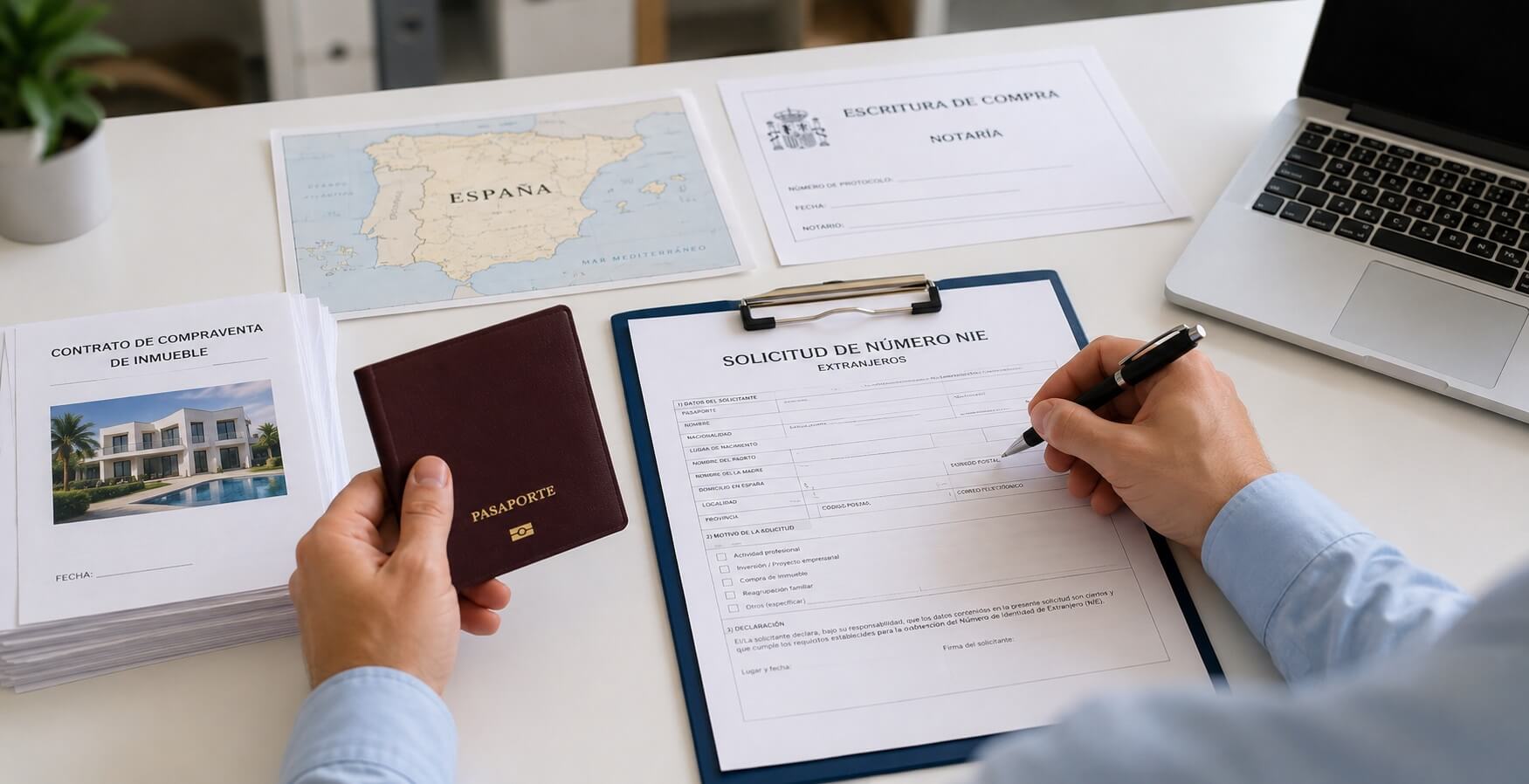


Moving to Spain for an extended period—whether to invest, relocate or enjoy a new lifestyle—comes with one essential administrative step: getting your NIE number Spain. This identification number is required for almost every legal, financial and immigration-related procedure in the country. Without it, many basic actions such as opening a bank account or buying property simply cannot be completed.
For expats from the United States or the United Kingdom, the process may seem confusing at first. Spanish bureaucracy operates differently, and requirements can vary depending on your situation. This guide explains everything you need to know, from what the NIE is and why it matters to how you can obtain it efficiently, avoid delays and ensure your long-term plans in Spain start on the right legal footing.
What is the NIE number in Spain?
Foreign nationals who plan to stay in Spain beyond a short visit will inevitably come across the NIE. It is a fundamental requirement for interacting with Spanish authorities, carrying out legal transactions and establishing any type of long-term presence in the country.
NIE foreign identification number explained
The NIE is the identification number assigned to foreigners in Spain. It is used by the Spanish administration to track any legal, financial or administrative activity carried out by non-Spanish citizens.
This Spanish NIE number is unique, personal and permanent. Once issued, it remains the same throughout your life, regardless of whether your residency status changes. It is required for a wide range of activities, from opening a bank account to purchasing property or paying taxes.
Difference between NIE, DNI and NIF
These three terms are often confused, especially by expats who are not familiar with the Spanish system. Here is a clear breakdown:
- NIE (Número de Identidad de Extranjero), identification number assigned to foreigners. It is used for legal, financial and administrative purposes in Spain.
- DNI (Documento Nacional de Identidad), national identity document for Spanish citizens. It includes both an identification number and a physical ID card.
- NIF (Número de Identificación Fiscal), tax identification number used for fiscal purposes. For foreigners, the NIE usually acts as their NIF.
What does an NIE number look like?
The NIE follows a specific format that distinguishes it from other identification numbers in Spain. It typically consists of a letter at the beginning, followed by a sequence of numbers and ending with another letter.
For example: X1234567A
The initial letter indicates the category of foreign resident, while the final letter is a control character used for verification. This format remains consistent and is recognised across all Spanish administrative systems.
Why you need a NIE in Spain?
Any foreign national planning to stay in Spain for more than a short visit will need an NIE at some point. It is the key that allows you to interact legally with institutions, sign contracts and carry out financial operations. Without it, many essential steps—both administrative and practical—simply cannot be completed. Below are the most common situations where an NIE becomes mandatory.
To buy property in Spain
Purchasing a property in Spain is one of the most common reasons why foreigners apply for an NIE. Spanish notaries and the Land Registry require this number to formally identify the buyer and register ownership. Without it, the transaction cannot be completed, regardless of how advanced the process is.
For example, if a British buyer wants to secure a property in Alicante, they will be asked for their NIE even before signing the deposit contract. In practice, the entire purchase process is blocked until the NIE is obtained.
To rent in Spain
Although not always legally mandatory, many landlords and agencies require an NIE before signing a rental contract, especially for long-term leases. It provides a reliable way to identify the tenant and ensures that the agreement complies with Spanish legal standards.
For instance, an American expat relocating to Valencia for a year may find that agencies request an NIE before approving the tenancy. Without it, the landlord may refuse to proceed or ask for additional guarantees, such as higher deposits or upfront payments.
For banking, taxes and legal procedures
Opening a bank account in Spain almost always requires an NIE, particularly if you intend to use the account regularly or for significant transactions. Financial institutions use this number to comply with anti-money laundering regulations and to link all financial activity to a verified identity.
In addition, the NIE is essential for dealing with the Spanish tax authorities. Whether you are paying income tax, purchasing a vehicle or registering utilities such as electricity or water, your NIE will be required. For example, even setting up a mobile phone contract in Spain can sometimes involve providing this number.
Setting up a company or investing
Foreign investors and entrepreneurs must obtain an NIE before starting any business activity in Spain. This number is required for registering a company and complying with tax obligations.
For example, if a US entrepreneur wants to launch a startup in Madrid, they cannot be listed as a company director without an NIE. Similarly, investors purchasing shares in a Spanish company or participating in real estate developments must provide this identification to complete the transaction legally.
Dealing before a notary
Notarial procedures in Spain are highly formal and require proper identification of all parties involved. The NIE is mandatory for any act signed before a notary, including property purchases, powers of attorney and inheritance matters.
For example, if a UK citizen grants power of attorney to a lawyer in Spain to manage a property purchase, the notary will request their NIE before validating the document. Without it, the act cannot be authorised, and the process will be delayed.
Applying for a long-term visa
For expats planning to stay in Spain beyond 90 days, the NIE becomes part of the transition into legal residency. While it may not always be required at the very first stage of a visa application, it is typically assigned or requested shortly after approval.
For instance, someone applying for a non-lucrative visa may be issued an NIE alongside their residency process. Having it early can simplify administrative steps such as registering with local authorities.
Working in Spain
Anyone intending to work in Spain must have an NIE, as it is required for employment contracts, payroll processing and registration with the social security system. Employers cannot legally hire a foreign worker without this number.
For example, if a Canadian professional secures a job in Barcelona, the company will need their NIE to register them with social security and begin paying their salary. Without it, the employment relationship cannot be formalised, and the worker cannot start legally.
How to get the NIE number in Spain?
Obtaining an NIE is a formal administrative process that requires preparation, correct documentation and, in many cases, patience. While the procedure is straightforward in theory, in practice it can become time-consuming due to appointment availability, local requirements and administrative delays.
Documents required
Applicants must submit a set of documents that prove both their identity and the reason for requesting the NIE.
The most important requirement is a valid passport, along with a completed official application form. In addition, authorities will ask for documentation that justifies the request, such as a property purchase agreement, a job offer or proof of investment.
For example, if you are applying because you intend to buy a property, you may need to present a reservation contract or a letter from a real estate agent. If your reason is employment, a signed job offer may be required. The key point is that the Spanish authorities expect a clear and legitimate reason for issuing the NIE, and generic explanations are often not accepted.
Where to apply?
There are two main ways to apply for an NIE:
- In Spain, applications are usually submitted at designated police stations that handle foreigner documentation. Appointments are required and can be difficult to secure, especially in major cities.
- Alternatively, you can apply through a Spanish consulate in your home country, such as in the United Kingdom or the United States. This option is often more convenient for those who want to organise everything before arriving in Spain. However, processing times may be longer, and requirements can vary depending on the consulate.
Can you apply for a NIE online?
The process cannot be completed entirely online. While forms can be downloaded and appointments can sometimes be scheduled digitally, the application itself requires physical presence or representation. This is because authorities need to verify identity and original documentation.
For example, even if you fill out all forms online in advance, you will still need to attend an appointment in person or provide a legal authorisation for someone to act on your behalf. Understanding this limitation is important to avoid unrealistic expectations and unnecessary delays.
Applying through a legal representative in Spain
Many expats choose to appoint professionals to handle the NIE application on their behalf. This option is particularly useful if you are not yet in Spain or if you want to avoid dealing with administrative procedures directly. By granting a power of attorney, a legal representative can submit documents, attend appointments and manage the process for you.
Working with experienced lawyers to get NIE can significantly simplify the procedure. They ensure that all documentation is correct, appointments are handled efficiently and potential issues are resolved quickly.
The Spanish NIE number processing time and validity
Understanding timelines and validity is key when planning your move or investment in Spain. Delays in obtaining your NIE can directly affect property purchases, visa applications or even opening a bank account, so it’s important to know what to expect.
How long does it take to get an NIE in Spain?
Processing times depend largely on where and how you apply.
- In Spain, some applicants receive their NIE within a few days, especially in less busy locations, while in major cities it can take several weeks due to high demand and limited appointments.
- If you apply through a consulate in the UK or the US, the process is usually slower, often taking between two and six weeks.
Using a legal representative can sometimes speed things up, particularly when timing is critical for a property purchase or investment.
How long does a Spanish NIE last?
The NIE itself is permanent and assigned for life. Once you receive it, you will use the same number for all your activities in Spain, regardless of changes in your residency status.
However, the certificate issued with the NIE may be required to be recent for certain procedures. For example, banks or notaries may ask for a document issued within the last few months, even though the number itself does not expire.
Common delays and how to avoid them
Delays are one of the most frequent frustrations for expats applying for an NIE. Most issues can be avoided with proper preparation and planning:
- Lack of available appointments, booking slots can be limited, especially in cities like Madrid or Barcelona. It is advisable to schedule your appointment as early as possible.
- Incomplete or incorrect documentation, missing documents or errors in forms often result in rejected applications or the need to rebook appointments. Double-check everything before submission.
- Unclear reason for the application, authorities require a valid justification, such as buying property or working in Spain. Vague explanations can lead to refusal.
- Applying during peak periods, summer months and holiday seasons tend to increase demand, slowing down the process significantly.
- Language barriers and administrative misunderstandings, miscommunication can cause delays or mistakes. Having professional support can help avoid these issues.
- Consulate processing delays, applications made from abroad may take longer due to additional administrative steps and lower processing capacity.
NIE vs TIE: what’s the difference?
Many expats initially think that the NIE and the TIE are the same, but they serve very different purposes. While both are essential for foreigners in Spain, one is simply an identification number and the other is a physical residence card that proves your legal status in the country.
What is the TIE card in Spain?
The TIE, or Tarjeta de Identidad de Extranjero, is a physical card that confirms your legal residence in Spain. It includes your NIE number, personal details and the type of residency authorisation you hold.
Unlike the NIE, which is just a number, the TIE serves as official proof that you are allowed to live in Spain for a specific period. It is required for many day-to-day activities, such as registering your address, accessing public services or travelling in and out of Spain as a resident.
When do you need a TIE instead of an NIE?
The NIE is sufficient for short-term or specific activities, such as buying property or opening a bank account. However, if you plan to stay in Spain for more than 90 days, you will need a residence permit, and this is where the TIE becomes necessary.
For example, if you obtain a non-lucrative visa or a digital nomad visa, you will need to get a tie card in Spain after arriving in the country. This card formalises your legal stay and replaces the NIE certificate as your main identification document for residency purposes.
Transition from NIE to residency card
The transition from NIE to TIE usually happens once your long-term visa has been approved. After entering Spain, you must book an appointment to provide biometric data and complete the process to receive your residence card.
During this stage, your NIE remains the same, but it becomes integrated into your TIE. From that moment on, your legal status in Spain is tied to your residency card rather than just the identification number. This step is essential for anyone planning to live in Spain on a long-term basis.
Common mistakes when applying for an NIE number
Applying for an NIE may seem straightforward, but in practice many expats face delays or rejections due to avoidable mistakes. Spanish authorities are strict when reviewing applications, and even small errors can force you to restart the process or wait weeks for a new appointment.
Incorrect or incomplete documentation
One of the most frequent issues is submitting documentation that is missing, outdated or incorrectly filled out. Authorities require specific forms, valid identification and clear supporting documents that justify the request.
For example, presenting a passport with insufficient validity, forgetting to sign the application form or failing to include proof of the reason for applying can lead to immediate rejection. In many cases, applicants are asked to book a new appointment, which can significantly delay the process.
Not having a valid reason for application
Spanish authorities do not issue an NIE without a clear and legitimate purpose. Simply stating that you may need it in the future is not enough. You must demonstrate a concrete reason, such as buying property, starting a job or making an investment.
For instance, if you are planning to purchase a home, you may be asked to provide a reservation contract or a letter from a real estate agent. Without this type of evidence, your application may be denied or postponed.
Booking issues and appointment delays
Securing an appointment is often one of the most challenging parts of the process. In many cities, available slots are limited and can be booked weeks in advance.
Applicants who do not plan ahead may find themselves unable to get an appointment in time for important deadlines, such as property purchases or visa applications. In addition, missing an appointment or arriving late usually means starting the process again.
Applying too late
Many expats underestimate how long the NIE process can take and delay their application until the last minute. This can create serious problems if the NIE is required urgently for a transaction or legal procedure.
Language barriers and misunderstandings
Administrative procedures in Spain are often conducted in Spanish, which can create confusion for expats who are not familiar with the language. Misunderstanding instructions or requirements can lead to errors in documentation or missed steps.
Not using professional assistance when needed
While it is possible to apply for an NIE independently, some situations are more complex and require expert support. Attempting to manage the process without proper knowledge can lead to mistakes, delays and unnecessary stress.
Pellicer & Heredia helps you with NIE and TIE applications
Managing immigration procedures in Spain can be more complex than it initially appears, especially when dealing with different authorities, strict documentation requirements and limited appointment availability.
At Pellicer & Heredia, we assist clients throughout the entire process, from obtaining the NIE to completing residency procedures and securing the TIE card. Our team ensures that your application is properly prepared, your documentation is accurate and your case progresses efficiently without unnecessary complications. Whether you are relocating, investing or planning a long-term stay, we provide tailored support adapted to your specific situation.
Beyond the initial application, we also advise on ongoing immigration requirements, including tie card renewal in Spain, helping you maintain your legal status without interruptions. Our objective is to offer clear, reliable and professional assistance so you can focus on your plans in Spain with complete peace of mind.
For more information or assistance, contact Pellicer&Heredia on + 34 965 480 737 or email at info@pellicerheredia.com

